
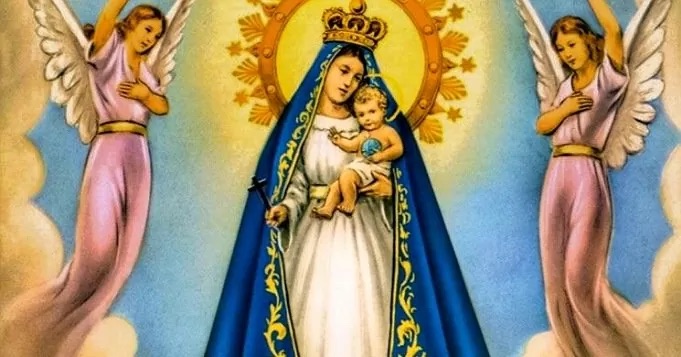
The sun shined strongly that day, but I could not see due to the glimmer of the water glowing back to me. We walked towards the malecón, wearing yellow shirts and holding sunflowers. The Miami heat made the walk feel eternal as we reached our destination. As we took our place, my mom told me to do a cross and to ask the Virgin for good things for myself and my family. We had arrived in Miami days prior on September 4th, and we became part of the growing beneficiaries of the “wet foot, dry foot” policy. Through this, we entered the Miami Cuban exile community, and at the office of immigration requested political asylum in the United States. I looked around me and picked up on the familiar Cuban accent, the priest called our gaze towards the small figure at the center of the portable stage, as I gazed over her golden veil, I could not help but notice a small pinned Cuban flag on her left side. The priest welcomed us to la Ermita de la Caridad, asked us to commence, and thanked us for coming together to worship “la madre de los Cubanos.”
Los Exiliados Y La Virgen
Upon Fidel Castro’s rise to power, Cuban Catholics found themselves fleeing the island. Often associated with anti-Revolutionary activities, the Castro government began to close on the churches and their leaders (Neville, n.a.). Over 130 of the island’s priests fled the country in the first year of El Comandante’s rule and with the nationalization of property, the churches became property of the State, therefore, abandoning its ‘neutral’ ground (Neville, n.a.; Pedraza, 5). To many Catholic Cubans, the actions of the Revolution could not be reconciled with their faith; the idea of taking from one did not seem to fall in line with what the Bible intended. With this, over 124,000 Catholic, white, middle-class, Cubans made their way to the United States and settled across the country.
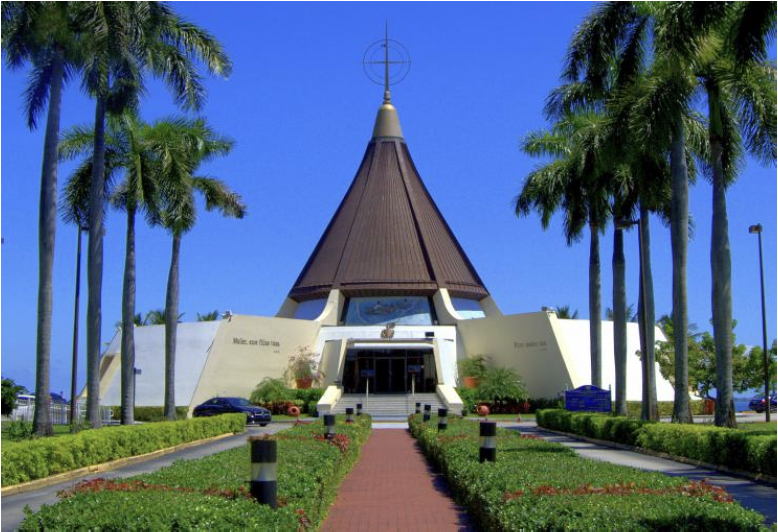
In 1961, the Catholic exiles in Miami sought to bring to exile with them their mother, La Virgen de La Caridad del Cobre. The lack of protection and supervision by their mother was felt so deeply, that the Catholic exiles engaged in a mission to smuggle a small replica of the original statue of the Virgin from La Habana (Tweed, 15). A representative of the Panamanian embassy in Cuba, secured the figure, and gave it to Luis Guitiérez Areces without informing him of the treasure he was transporting. Unknowingly, Areces set forward to take Cachita, as her followers lovingly call her, through the experience of exile her Catholic children underwent. The exiles set out to develop a monument for the Virgin in their new home and hoped to reconcile the religious veneration that the Communist state of the island had taken away from them. This monument, known as la Ermita de la Caridad, is recognized as a national patrimony by the Catholic Church and a known symbol for the community of Cuban exiles in Miami.
Since 1961, the Cuban enclave has grown in power and influence; thus, allowing the development of a community in Miami and in nearby areas that reflects their ideals. Like with the creation of la Ermita, the Cuban community has developed a society in Miami, based on what author, María Cristina Garcia describes as the “three C’s: Communism, Castro, and Cuba” (3). The formation of the Cuban community is grounded in this foundation, the parameters for what is allowed to be expressed must align with the exiles’ three C’s agenda -centered on Cuba but fiercely anti-Communist and anti-Castro. Thus, monuments erected by the exiles transform the space of their host country and create a reminder to the onlooker of the desire of return to the motherland that exiles dream of and the fall of Castro’s government. As João Felipe Ferreira Gonçalves argues in his dissertation, the monuments “reproduce the basic premises of Cuban nationalism - that Cuba is an actual collective subject that deserves being sovereign,” and through the settling of these monuments, “their creators were at the same time reproducing Cuban nationalism and intervening in the Miami landscape.” (175, 176) Therefore, monuments like la Ermita serve as more than just an attraction, but rather they communicate and place the onlooker in a performance of the three C’s, by simply visiting these sites, the individual is performing the Cuban exile political agenda: that of the fall of the Communist state.
Thus, the creation of la Ermita de la Caridad by the Cuban exiles in Miami is not simply to further the Catholic religion, rather it is a performance of exiled Cuban Catholicism. All aspects of la Ermita communicate a message by the exiles who share their hopes of change for the island, but the biggest performance of hope is given to “la madre de todos los Cubanos,” Cachita.
La Madre Y La Política
La Virgen de la Caridad del Cobre is described as a symbol of Cuban identity. In 1998, Pope John Paul II crowned the Virgin the patron saint and queen of Cuba (Davis, n.a.). In the eyes of many, the Virgin serves as more than just a symbol of the church, she is not a distant icon, rather their worship emulates the feelings of love and adoration that one feels towards their mother. In the New Testament descriptions of Mary, the mother of Jesus, her role remains that of mother, she stops appearing by name once her son has ascended into the kingdom of God (Rancour-Laferriere, 2). Thus, the attributes and qualities of the Virgin in the minds of followers remain to be that of mother.
The expectations have developed across the New World differently and in the time of colonial rule, when the New World Virgins were first encountered, the images of them were often used “alternatively, and sometimes simultaneously, as a symbol of liberation as well as one of accommodation and control.” (Peterson, 39). Not only that, but the construction of the cult of Virgins across the Spanish-speaking New World, led to the formation of “Marianismo”: "the emulation of the Virgin and the proclamation of women as semi-divine and morally and spiritually superior to men because she is able to endure immense pain and sorrow” (“Marianismo,”1407). With this, the image of the Virgin is linked not only to motherhood and the biological act of birthing but also to her emotional and physical sacrifices.
In turn, the representation of the Virgin for the Cuban exiles has been linked with her role as a self-sacrificing mother. Professor Rachel E. Harding in “Mysticism and Mothering in Black Women’s Social Justice Activism-Brazil/USA,” provides a definition of mothering that best articulates the expectations of the Cuban exiles towards their mother, Cachita: “includes the biological birthing process but extends to encompass the generation of ideas and solutions to family and community problems as well.” (228). Thus, La Virgen de la Caridad del Cobre is tasked to be a symbol of hope for the exiles, but is also expected to aid in the liberation of the Cuban people according to the exiles; as the mother of all Cubans, her exile places her in a position of favoritism towards her Cuban children in the U.S. and leaves her image of the protector of the mines of El Cobre and as the patron saint of Cuba to become an advocate and helper in the escape of her Cuban children from the Castro regime.
Purpose
The representation of Cachita in la Ermita de la Caridad del Cobre serves as a strong link between her image, Cuban identity, and politics. Through her representation in la Ermita, Cuban exiles have been able to re-write a history of Cuba before Castro and without any influence from the Revolution. Haitian anthropologist, Michel Trouillot, positions the past as a creation from a collective to support the existence of themselves; he establishes that there is no way to assess the impact of a past event in the future until future generations find themselves choosing to confront its legacy (16). Likewise, la Ermita de la Caridad focuses on reshaping the history of Cachita and shifts her role as the mother of the island to become the mother of the exiles.
Therefore, in this essay, I aim to interrogate the expectations that are placed on the Virgin because of her identity as mother and how these expectations lead to the construction and performance of the deity that aligns with the political agenda of the Cuban exiles in Miami. Guided by Harding’s definition of mothering, I will provide a history of La Virgen de La Caridad del Cobre’s appearance in Cuba and her journey to exile in Miami. Ultimately, depicting the way that Cubans in Miami set the Virgin to perform the Cuban-American anti-Castro political agenda through the construction and patronage of La Ermita de la Caridad del Cobre; I will strengthen this analysis through the examination of the icon of the Virgin at the center of the church and the mural that surrounds her. I seek to understand the Cuban exile’s longing for their motherland through the veneration of their Holy Mother. Thus, I will complement my analysis with existing ethnographic research on the Virgin and her cult, as well as research focused on the expected gender roles that result from Marianismo, to draw an analysis on the importance that Cachita being a mother has on the representation of her figure and her role in the political discourse of the Cuban exiles.
This project aims to add to the literature about La Virgen and her role as a political agent. I hope this project will also generate a larger conversation about the impact of feminine religious icons on Cuban-American political formation and development.
La Historia Y La Patrona: Divina Creación
La Virgen de la Caridad del Cobre has her origins in Cuban history starting in the 1600s. Professor of Latin American Studies, María Elena Díaz, tells the details of the origin of Cachita by connecting her to the development of the copper mines in colonial Cuba. According to the legend, in El Cobre, Santiago, at the age of ten, royal slave Juan Moreno and two indigenous brothers were on their way to salt mines by the way of a canoe, they saw what appeared to be a bird in the foam of the seam but upon drawing closer to it, they realized there was an effigy of a Virgin engraved with the words: “I am the Virgin of Charity” (Díaz, 99). The boys took the figure and brought her to Captain Don Francisco Sánchez de Moya, who was the administrator of the copper mines were the boys worked at the time (Díaz, 99). With this, Moya ordered that an altar be built in her honor. However, the Virgin through the span of a couple days, made her desire to be placed next to the copper mines known by protesting through supernatural actions until placed in Cerro de la Mina, right next to the mines (Díaz, 100). Thus, her demand to be next to the mines, transformed her into what Díaz describes as “the protector of the mines and the slaves, their representative in their supernatural sphere” (100).
Since working the copper mines was a dangerous job to have, the Virgin became “una madre veladora.” Her overseeing and protection of the miners during the work day resonates with the expectation in Marianismo, in which Cachita worries for her children and places herself in a “dangerous” situation to ensure their safety (that is, living next to the mines) (Hussain et al., 74). Self-sacrificing and acting in Hardings definition of mothering, the establishment of Cachita’s effigy next to the mines where the African slaves and the indigenous people worked, brought with it the subversion of the order of colonial society at the time; the mysticism recounted by Moreno, a royal slave, brought forward the Virgin who with her presence was able to improve the conditions of the royal slaves of El Cobre, who were fighting for claim to land (Díaz, 103). Therefore, aligning her self with the interest of her children, as a Virgin who is part of the cult of Marianismo, Cachita sought to represent the voices of the slaves and the indigenous people of Cuba, specifically those of El Cobre.
Viewing her alignment with the miners of El Cobre, the relationship between Cachita and the miners reflected that of mother and sons in the cult of Marianismo. An article by the Journal of Feminist Family Therapy, establishes that in the face of Marianismo, the honor of men is dependent on the behavior of women (Hussain et al., 75). In this case, the honor of property-owning and advancement of slaves in El Cobre came at the labor of their newfound mother and her constant act of relocation to the area of the mines until her shrine was erected there. However, as Michael T. Taussing establishes, “each change in the mode of production and each new development of political struggle add new meanings and transformations to the symbolization of the spirit” (144). Meaning with the development of the mining industry and the expansion of the cult of la Caridad through all of Cuba upon the Catholic churches recognition of the icon, Cachita adopted more children and with them new maternal worries.
La Virgen de la Caridad del Cobre is consistently called to resolve conflicts. The same way a mother is expected to resolve the issues between her children who are fighting and to protect her children from evil, Cachita has been invoked during the war of Independence and the Revolution. With the victory against Spain, Cachita solidified her status as “la patrona de Cuba,” she protected her children in battle and returned them to safety, once more providing solutions to the problem of her kin (Tweed, 24). Likewise, during the initial phase of the revolution, la Virgen de la Caridad del Cobre was called upon to bring the rebel army of Fidel Castro to safety with a prayer published in the “liberty issue” of the magazine Bohemia, which gave thanks to Cachita for the victorious return of her sons to La Habana after a year of horrific battles (Tweed, 25). Intertwined with the fabric of social and political change, “la madre de los Cubanos” held the hands of her children and carried them to the advancement they desired. In securing the happiness of her children, Cachita sacrificed her status amongst the European Virgins. The worship of her figure in Cuba was not simply restrained to the space of the church, rather believers consistently worshipped the Virgin in their homes (Tweed, 18), leading to a restraining of the Virgin to the role of ‘home-maker,’ that is her spiritual properties were concentrated in her children and their homes, accommodating their needs as opposed to requiring her children to visit her.
Furthermore, as Castro’s power grew, Cuban Catholics fled the island. The image of the Virgin was central to those Catholics fleeing and serving in counter-revolutionary missions. In 1980, a bus driver wearing the image of Cachita, drove through the gates of the Peruvian embassy in La Habana and attributes his success on arriving to the U.S. on the support of his mother (Hall, 276); sacrificing her following in the island, the Catholic exiles appropriated Cachita as the mother of those who sought to escape the island, rather than those who were complicit in Castro’s government. With her children split, “la madre de todos los Cubanos” became a link between national identities and the politics that divided the exiles from their homeland.
La Ermita de La Caridad: Mamá No Se Equivoca
As previously mentioned, on September 8th, 1961, over 25,000 Cuban Catholics gathered in Miami Stadium unaware of the surprise guest traveling from the island. Seeking to honor the memory of their Virgin mother, the exiled Cubans were moved to tears upon the unexpected sight of the effigy of Cachita. Gina Nieto, one of the attendees in the ceremony, told el Nuevo Herald, “Fue un momento muy lindo, muy lindo. Como si me hubieran traído a la madre para acá también. Digo, la madre está aislada con nosotros aquí.” (6:04-09). The arrival of the mother to the newfound homeland of a portion of the exiled Cubans brought a sense of security and it symbolized a unification with their mother that for some who left the island would never come.
Recognizing the organizational disengagement of Catholic Cubans with the Church and seeing the turnout of the 1961 celebration of Cachita, Bishop Coleman F. Caroll encouraged the creation of a shrine in her honor. Inspired by the image of another ‘ethnic’ shrine in the United States, Caroll began to call on Cubans to donate and aid in the formation of the shrine, he established that the shrine would serve as “a constant reminder to all of her [Cachita’s] great powers of intercession -- of her willingness to help all who honor her.” (Tweed, 36). Caroll understood the devotion that the Cuban exiles felt for their mother and knew that the monetary contribution from the recently arrived Cubans would be received one way or another. However, with this began the conditional relationship between Cachita and her exiled children. In the U.S., it seemed that her love would only be given in the site of her shrine, the old way of venerating her at home would no longer be as powerful in strange territory. The physical presence of the Virgin and the collective worship by the Cuban exiles needed to be visible to allow her children to visualize an agent of change for the situation in Cuba and in their new life of exile.
La Ermita de la Caridad was constructed in an intentional and detailed fashion which allowed the centering of “la madre de los Cubanos” and her relation to the worshippers. Beginning with the location of the shrine, it is facing not just the water, but directionally it is located 200 miles from the island (Hall, 277). Furthering the connection between the island and the children she has left behind in her exile, the location serves as a pressing reminder of the family left behind. Likewise, the shape of the building itself emulates the figure and mantle of Cachita (Davis, n.a.), thus, allowing the visitor to “enter” into the divinity within La Virgen. This connection almost evokes a feeling of mysticism for the spectator who might be transported to a community separate from the outside world. In this space, the visitor enters into the womb of Cachita, as you look to the glass stained windows, the stories of the exile of Mary and Jesus decorate the stained glass windows (Davis, n.a.), but ultimately, the reminder of the diaspora lays behind the effigy of the Virgin.
As the visitor walks to take their seat, their gaze is directed to the effigy of the Virgin brought in 1961 and the mural behind her. Commissioned in 1977, Cuban-exiled artist, Teok Carrasco, spent over 364 hours painting the 747 square feet mural, which depicts Cachita holding baby Jesus in the middle and over sixty-three figures whom Carrasco thought of as central to Cuban history in the past and modernity (National Shrine of Our Lady of Charity, n.a.). Examining the mural, it is evident to understand that Carrasco sought to position Cachita as the mother of creation and the protector of the history of Cuba. On her left, the biggest figure is that of Cristobal Colón, who Carrasco recognizes as the one who brought over the faith and, thus, introduced Cuba to Cachita (National Shrine of Our Lady of Charity, n.a.) Likewise, the image of Cuban author, father of independence, and martyr, Jose Martí is enlarged and to the right of Cachita, his gaze looking down on the spectator.
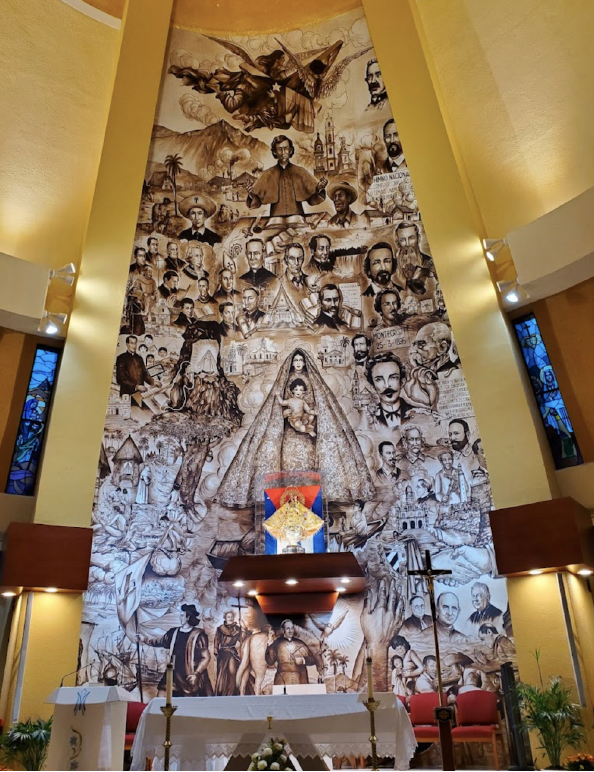
The mural features only one notable female figure, Mariana Grajales,but ultimately, it positions the image of a mother holding her child inside of a raft in the lower right corner. Additionally, there are no prominent figures of colors, the figure of Juan Moreno, the royal slave, is covered by the Cuban flag behind the effigy, and the indigenous brothers are transformed into white figures. The erasure of the figures of color from Cachita’s history reflects the history of the bourgeois exiles who first migrated to Miami during the Revolution; the history in la Ermita is the history of the white Cuban exiles.
While some of the figures are gazing away from the spectators, the majority of them are looking forward to the seats of the shrine. Positioning the figures, including the Virgin, to look down on the visitors and give a new meaning to the phrase, “history has its eyes on you,” rather, the mural creates a moment in which the past is reflecting to the present and it is “la madre de todos los Cubanos” who is in charge of uniting the historical past of Cuba with her children in exile. As Trouillot argues, the Cuban exiles through the construction of the mural, created a narrative around the past of Cuban history, that aligned with the morality of Cachita; positioning her in the front of the mural and placing her effigy in front of said mural enlarges her image and alludes to the maternal protection that she holds for her children. The mural behind the effigy develops a shadow to Cachita that enlarges her image from the small statue to a larger than life image. With this, the mural communicates to its onlookers the approval and support that Cachita offers to her children in exile and their desire for change in the island.
Evidently, la Ermita de la Caridad communicates a message to its visitors that the current state of Cuba is temporary. It holds clear connections to the island, while creating space to encourage visitors to explore avenues to return to the glory of the past that lies behind Cachita or to find comfort in the fact, that in the exile to the U.S. Cubans -no matter if they came without their kin- are not without their mother.
Conclusiones: Nunca dejas de llorar a tu madre
Bishop Emilio Aranguren Echevarría of the Cuban province of Holguín talks about the desire of some Cubans (in the island and away) of having Cachita unite the people once again. He discusses how her motherly love is sought out as a remedy to the tear of Cuban relationships (Catholic Radio and Television, 4:07-30). However, the growing development of the Cuban enclave in Miami, alongside its religious and political influence continues to demonstrate an ever growing divide amongst the exiles and the island. La Ermita de la Caridad positions Cachita as no longer a neutral party in this fight among her kids. The mural and the construction of the site, prove to the onlooker that the mother is leading and supporting the exiled communities in a manner that does not allow for casualties with their Communist sibling in the island.
The formation of the cult of Cachita in Miami not only restrained the love of the Virgin to her Catholic children who brought her to exile, but it demonstrates that the exiles sought the guidance of a mother in an unknown land. The iconography of Cachita and her association with the counter-revolutionary movement put her in a position in which she had to sacrifice her children in the island in order to follow those who needed her to hold their hand in an unknown land.
The comfort of the Virgin amongst the exiles laid on her motherly attributes, her ability to ‘solve’ the issues of her children through the experience of faith, as well as the comforting idea of love and morality that her image represent make her the perfect ally for the Cuban exiles who seek to solidify their ideology as the correct one as opposed to the one that rules the island. Thus, the alliance with Cachita, “la madre de todos los cubanos,” advances the morality of the Cuban exiles in the eyes of onlookers. Nothing beats a mother’s approval!
Works Cited
Catholic Radio and Television. “La Virgen de la Caridad del Cobre, madre del pueblo cubano.”
YouTube, uploaded by Aleteia ES, 12 Feb., 2012.
Davis, Jim. “La Ermita: the Miami home of Cuba's patroness.” Archdiocese of Miami, 24 August 2024, https://www.miamiarch.org/CatholicDiocese.php?op=Article_16584118209193.
Davis, Jim. National Shrine of Our Lady of Charity. 2024.
“The Devil in the Mines.” The Devil and Commodity Fetishism in South America, by Michael T. Taussig, University of North Carolina Press, 2010.
Díaz, María Elena. The Virgin, the King, and the Royal Slaves of El Cobre: Negotiating Freedom in Colonial Cuba, 1670-1780. Stanford University Press, 2000.
El Nuevo Herald. “Primera misa de la Virgen de la Caridad del Cobre en Miami, celebrada en 1961.” YouTube, uploaded by el Nuevo Herald, 8 Sep., 2021.
Farrot Peterson, Jeanette. “The Virgin of Guadalupe: Symbol of Conquest or Liberation?” Art Journal, 1992, pp. 39-47.
Ferreira Gonçalves, João F. The Hero's Many Bodies: Monuments, Nationalism, and Power in Havana and Miami. PhD Dissertation. The University of Chicago, August 2012, pp. 1-190.
Garcia, María C. “Hardliners v. "Dialogueros": Cuban Exile Political Groups and the United States--Cuba Policy.” Journal of American Ethnic History, 1998, pp. 3-28.
Harding, Rachel. “Mysticism and Mothering in Black Women's Social Justice Activism-Brazil/USA.” Life Under the Baobab Tree: Africana Studies and Religion in a Transitional Age, edited by Kenneth N. Ngwa, et al., Fordham University Press, 2023.
Hussain, Kiran M., et al. “Unveiling Sexual Identity in the Face of Marianismo.” Journal of the Feminist Family Therapy, vol. 27, 2015, pp. 72-92.
“Marianismo.” Multicultural America: A Multimedia Encyclopedia, edited by Carlos E. Cortés and Jane Sloan, SAGE Reference, A Division of SAGE Publications, Incorporated, 2013.
“Mary Moves North: Aspects of National Identity and Cultural Dissemination.” Mary, Mother and Warrior: The Virgin in Spain and the Americas, by Linda B. Hall, edited by Teresa Eckmann, University of Texas Press, 2004.
Neville, Antal. “Letter From Cuba: The Religious Revival of a Communist State.” Los Angeles Review of Books, 5 May 2013, https://lareviewofbooks.org/article/letter-from-cuba-the-religious-revival-of-a-communist-state/. Accessed 16 December 2024.
Pedraza, Silvia. Church and State in Cuba's Revolution. PhD Dissertation. University of Michigan, May 2009, pp. 1-11.
“The Power in the Story.” Silencing the Past: Power and the Production of History, by Michel-Rolph Trouillot, Beacon Press, 2015.
Rancour-Laferriere, Daniel. “Imagining Mary: A Psychoanalytic Perspective on Devotion to the Virgin Mother of God.” Taylor & Francis Group, 2017, pp. 2-6.
Rubio, Tania. Mural en La Ermita de la Caridad. 2024.
Tweed, Thomas A. Our Lady of the exile: diasporic religion at a Cuban Catholic shrine in Miami. Oxford University Press, USA, 1997.