

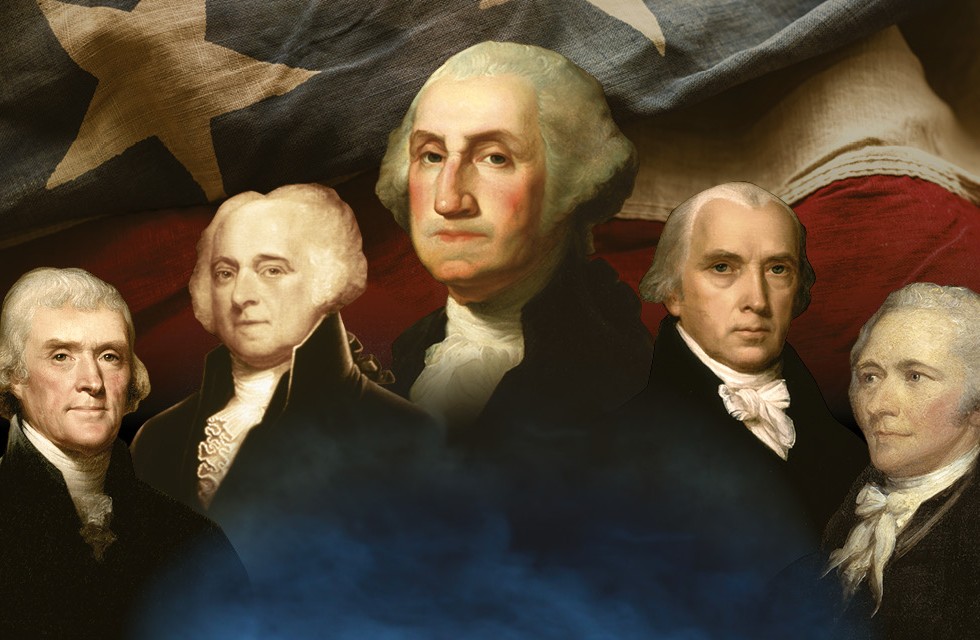
The United States was formed to be a “proper country.” A country where men fight for their people and the word of God guides them to the correct ‘law and order.’ This is why when we look at our currency we stare at the faces of the men who built this nation. Of course, that is the idea that American exceptionalists believe, the truth is that the patriarchal imposition of the country has served to provide the ‘law and order’ of those rich white men in power and the protection of the people who they deem worthy. These are the actual foundations of the United States.
English philosopher and writer, John Locke, was one of the influential figures of the thinking that created the nation. In his writing, Second Treatise on Government, Locke establishes that societies are formed after individuals enter into an agreement to give up some of their liberties in order to receive protection from the “state of war” (a constant state of violence that erupts among uncivilized beings) (10). From this creation of society, comes the distribution of power and the necessity for leaders to oversee the protection of their fellow citizens. Through his writing, however, Locke warns that “the power of a magistrate over a subject may be distinguished from that of a father over his children,” (4); meaning by this, that a man can hold the identity of father and political leader, but they can not intersect. To this point, the foundation of this nation strained from Lockean ideas.
Upon the “Revolutionary War” and the establishment of what became known as the United States, the veneration of the man that organized and pushed the British out of the country adopted the patriarchal form of structure. The nation became that of the Founding Fathers, the men were not just the founders, they were the fathers, and all of us remained their children. The paternalistic ideology tied to the founders of the nation provided white individuals with a false sense of security, by associating the founders with fathers the nation became associated not with love, but rather care. The sort of paternal care that takes from others to ensure their children live prosperously. The tying of the identities of both father and political figures set up a precedent in which the citizens and the rest of the nation could not defy nor question their parental authority; the term Founding Fathers became a means to subjugate and control the people; one sure would not like to upset their father.
Abolitionist writer Fredrick Douglass is aware of the phenomenon. In his speech, “What to the slave is the 4th of July?” Fredrick proceeds to call out the people of the United States for their compliance with slavery. He begins his speech by praising the setting up of the nation, he even compliments the braveness of the founding fathers in their fight against British oppression: “Your fathers staked their lives, their fortunes, and their sacred honor, on the cause of their country.” (3) Douglass is a skilled writer and speaker, he knows that you do not attack someone’s father and meet no opposition. In order to work with his audience, Douglass takes the identity of the fathers and their intertwined political power and uses it to guide his speech. He proceeds to comment on the fact that slavery continues in this country and that the paternal blessings of the Founding Fathers fall only to the white men who receive the “rich inheritance of justice, liberty, prosperity, and independence,” (4); Douglass deliberately uses familial terms so as to further connect the paternalistic relationship with the political one. Thus, Douglass is setting up the stage to establish that the perpetuity of slavery comes from the hands of the Founding Fathers and continues on their behalf through their children and the institutions that the Fathers ingrained into the value of this country.
Therefore, Douglass proceeds to specifically single out the Constitution. He proceeds to establish that slavery is “part of that Constitution framed by the illustrious Fathers of this Republic” (13); he recognizes that the veil of ignorance is drawn from the paternal identity as he continuously emphasizes their role as fathers of the nation, not just as the founders. This he knows will bring with it a big reaction, and he proceeds to call them “the veriest imposters that ever practiced mankind” (13). His speech is calculated and insults the nation’s fathers whose children remain in power and hold that their fathers could do no wrong, he is seeking to utilize the father-child relation to push their children towards the path of abolition. Through his speech, he presents the ways in which the country and the fathers perpetuated slavery and he singles out those instances and contrasts them with the principles by which the fathers built the nation, thus, proving that the institution of slavery and the prosperous Republic of the United States can not co-exist.
The Founding Fathers overlooked Lockean ideas and intertwined their identities as politicians and fathers. The loyalty towards them became a matter of family principle; however, as Douglass pointed out it also became a weak point through which pressure could be applied to seek change because, as Freud would say, this intertwining of identities left the nation with father issues.
Work Cited
Douglass, Frederick. What to the slave is the 4th of July? 1852.
Locke, John. Second Treatise of Government. 1690.